The Manchester United Problem: Why "Vibe Learning" Doesn't Solve Your Transfer Problems
Transfer is the ultimate goal of most learning, and is not simply solved with better technology or more funding

There are two types of people in the world.
People who understand the gravity surrounding the September 1st deadline, and those who have no idea what Deadline Day even is.
Deadline Day for football fans around the world is the last day when clubs can transfer in new recruits. While it is an exciting time for the fans, it’s an incredibly difficult period for the professionals managing the process.
Despite football clubs this summer spending over£2.5 billion on transfers, historical data shows that less than half of these transfers will actually succeed.

There are many reasons behind this high failure rate but several of them go back to being able to replicate performance from one context to another. An idea known in learning science as “transfer”.
Transfer is in many ways the goal of learning. It’s why people pick up new skills: to be able to use them when they need them. Transfer in education is divided by learning scientists into two types. They are near transfer and far transfer.
Near transfer is the ability to translate skills into similar tasks and environments from where the knowledge was gained. Far transfer is the ability to generalize the knowledge and translate those skills further into different tasks and novel environments.
In many ways, far transfer is considered the golden standard of good teaching and learning.
Very similar to the world of football transfers, learning transfer is often rare and difficult. It needs meticulous preparation and intentionality and will rarely happen by chance.
From the perspective of cognitive and learning science, there are at least four key concepts that can help us design for better, and especially far transfer.
Activate Prior Knowledge: Learners interpret new information through the lens of what they already know. This means appropriate prior knowledge is a foundation for transfer.
Ensure Deep Understanding: Rote learning provides a very poor base for transfer. A basic principle is that deeper understanding supports flexible use of knowledge into different contexts.
Foster Abstraction: Abstract mental representations help learners take deep understanding to new contexts. Knowledge that is overly grounded in the original context can hinder transfer. Learners need to understand the general principle behind a skill or idea so they can recognize it in different contexts.
Teach Metacognition & Self-Monitoring: All the above is only helpful if learners are keen on transfer. An often-underappreciated cognitive factor in transfer is the learner’s ability to monitor and adjust their own learning in line with agreed on transfer objectives.
These principles can be translated into the classroom, learning apps, or large language models. The most prominent three design principles that follow from the ones above remain:
Ensure you understand where learners are starting from so you can build on and make the necessary connections to relevant prior knowledge.
Design instruction to highlight the underlying principles and explicitly discuss transfer goals - so that learners can see how concepts apply across domains and settings.
Teach using methods that engage learners in active learning. The research is clear that active learning leads to better transfer than passive reception (e.g. problem-based learning, inquiry projects, or open-ended questions etc. that force learners to go beyond memorization into analysis, synthesis, and application)
While most if not all these principles have been abundantly clear for decades, we seem to forget them with every new technological wave.
The rise of “vibe learning” - quick AI-assisted learning that feels smart but doesn’t embed deeply - is just another example. Vibe learning is about the peak of just-in-time, fast, learning that sounds great but doesn’t transfer. It’s particularly attractive because we are all very poor judges of how well we learn.
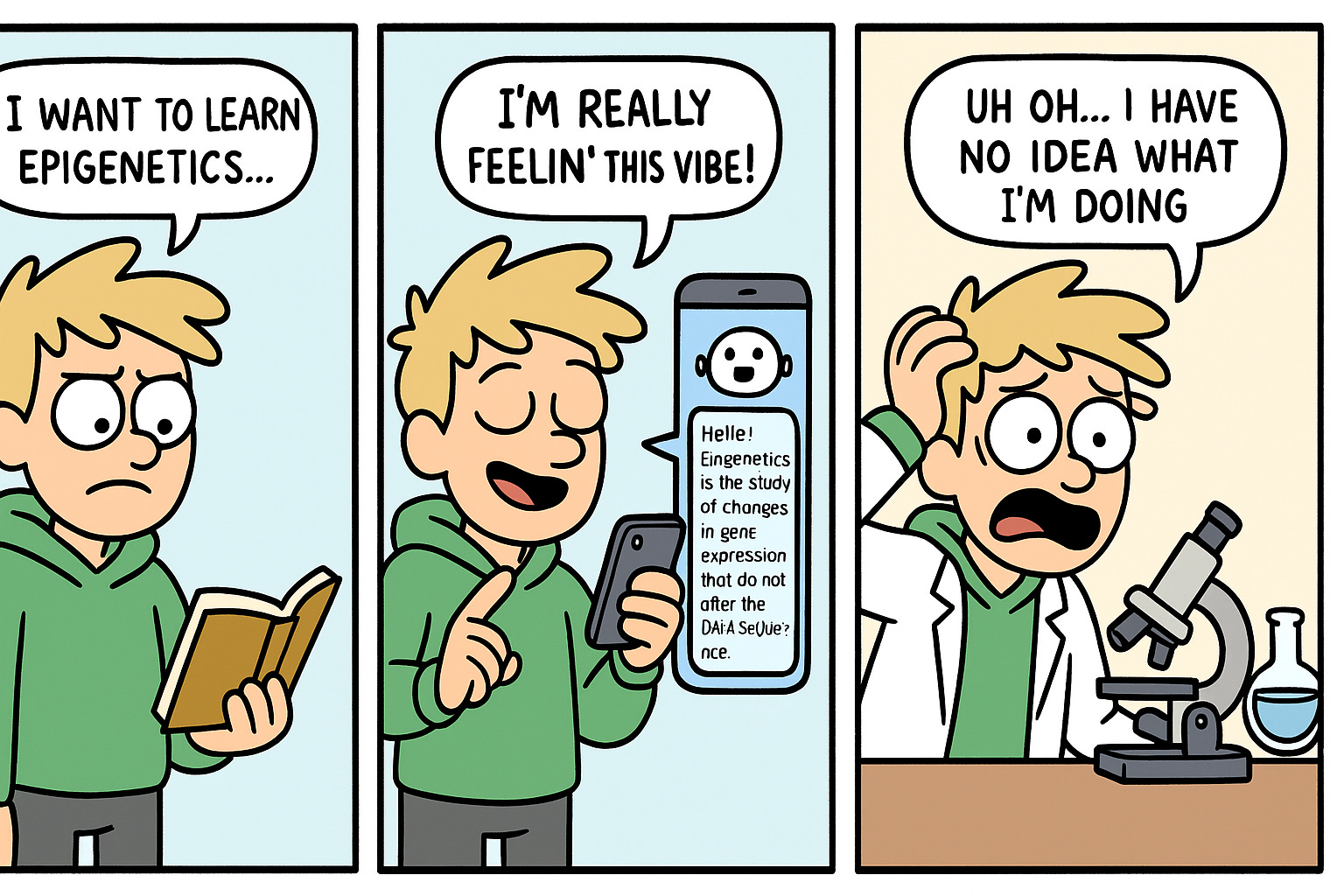
Despite the best efforts of many of the behemoths behind the foundation models, and the myriad of new startups popping up seemingly everyday, the focus remains primarily on creating “easy” or “fast” learning experiences instead of ones focused on deep understanding and transfer.
In order to make that paradigm shift we need to move beyond our obsession of falsely simulating the socratic method with a robotic Q&A in a chat box (even if the bot on the other side refuses to just “give you” the answer).
First, we need to be using AI to first understand the kind of transfer we want to create. The Q&A chatbot might work well for this part of the assignment at least.
Second, we need to emphasize productive failure by creating varied and multimodal target practice. AI can certainly help here but we really need to liberate the learning experience and think outside the “chat box”.
Third, we need to remember that friction is a very valuable part of the learning experience. This is two fold: first the centrality of human relations which are by definition frictionful, and second the need for desirable difficulty in learning.
Fourth, no amount of AI or technology will solve the “motivation problem”. Unless learners are with us on the journey and keen on creating transfer we will be going around in circles. As a lot of wise men and women have said before: start with why.
Finally, it’s important to keep in mind that pouring more money into the problem is no guarantee for creating positive transfer. Just ask the lovely people over at Manchester United.
I hope you enjoyed the last edition of Nafez’s Notes.
I’m constantly refining my personal thesis on innovation in learning and education. Please do reach out if you have any thoughts on learning - especially as it relates to my favorite problems.
If you are building a startup in the learning space and taking a pedagogy-first approach - I’d love to hear from you. I’m especially keen to talk to people building in the assessment space.
Finally, if you are new here you might also enjoy some of my most popular pieces:
The Gameboy instead of the Metaverse of Education - An attempt to emphasize the importance of modifying the learning process itself as opposed to the technology we are using.
Using First Principles to Push Past the Hype in Edtech - A call to ground all attempts at innovating in edtech in first principles and move beyond the hype
We knew it was broken. Now we might just have to fix it - An optimistic view on how generative AI will transform education by creating “lower floors and higher ceilings”.